
 Europe
 Austria
 Belgium
 Bulgaria
 Croatia
 Czech Republic
 Denmark
 Estonia
 Finland
 France
 Germany
 Greece
 Hungary
 Ireland
 Italy
Italy Latvia
 Lithuania
 Luxembourg
 Malta
Malta Netherlands
 Norway
 Poland
 Portugal
 Romania
 Slovakia
 Slovenia
 Spain
Spain SwedenEurope
On this page
Motivation
Why alpine pastures matter
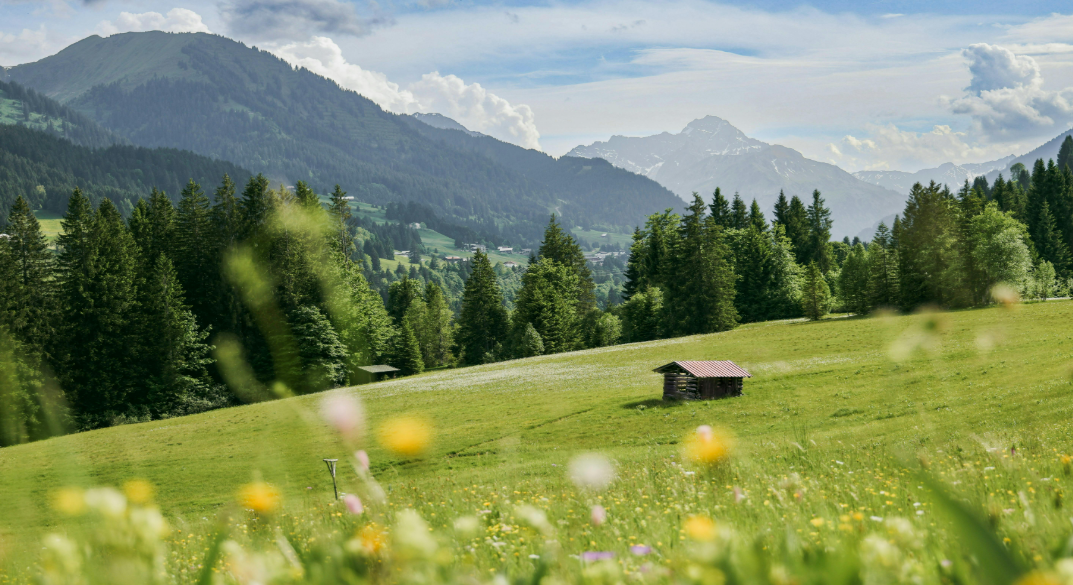
Traditional alpine pasture as part of the Austrian mountain landscape; Source: Pexels
Alpine pastures (Almen) are a defining feature of Austria’s mountain landscapes. Over centuries, seasonal grazing, local knowledge transmission, and adaptation to challenging environmental conditions have shaped these systems and contributed to their cultural significance. In 2023, transhumance (the seasonal movement of livestock) was inscribed on UNESCO’s Representative List of the Intangible Cultural Heritage of Humanity, highlighting alpine pastoralism as a living cultural practice of outstanding value (UNESCO, 2023).
Beyond their cultural role, those Almen provide important environmental benefits. Extensive grazing helps maintain open landscapes, slows shrub encroachment, and supports high levels of plant and insect diversity. Alpine grasslands contribute to habitat heterogeneity, soil protection, and the regulation of water runoff, particularly in steep mountain terrain. Their contribution to maintaining semi-natural mountain landscapes makes them especially relevant for biodiversity conservation in the European Alps (Bätzing, 2015). However, environmental outcomes depend strongly on grazing intensity and continuity of use. Excessive grazing pressure can lead to soil compaction, vegetation damage, and increased erosion risk, especially on steeper slopes (e.g., Centeri, 2022). This highlights that environmental benefits are not automatic but depend on appropriate management.
In addition, alpine pastures are an important component of regional economies. They support livestock farming, enhance alpine tourism by maintaining attractive cultural landscapes (and infrastructure), and contribute to regional agricultural value chains. At the same time, alpine pasture systems are economically vulnerable, particularly in the context of demographic change, structural transformation in agriculture, and shifts in policy frameworks (Flury et al., 2013).
Historical developments: 1920 to 2020
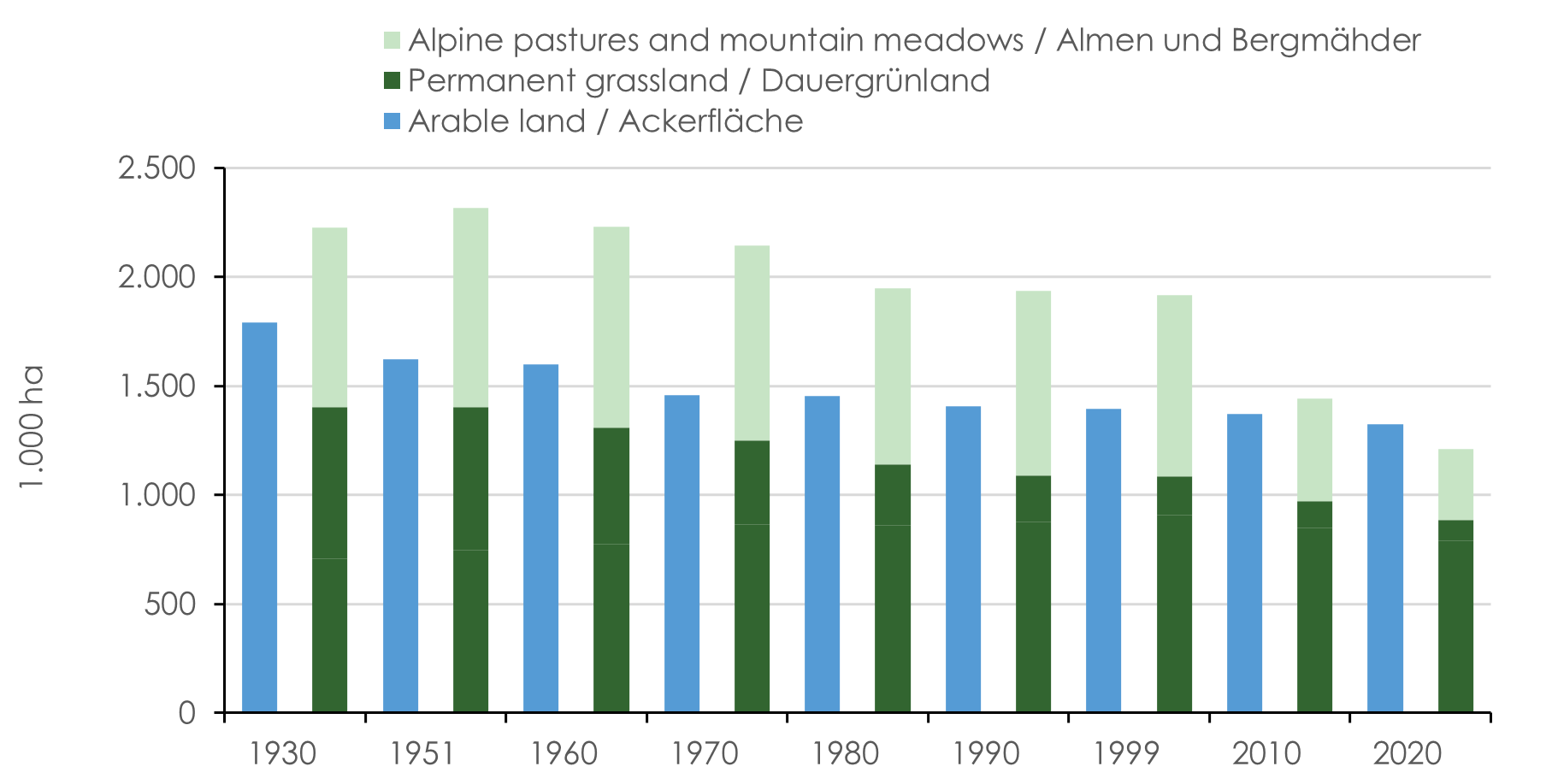
Figure 2: Development of arable and grassland area and arable land per capita; Source: Sinabell & Renhart, 2024)
Figure 2 shows the long-term development of alpine pastures and mountain meadows in Austria from 1920 to 2020.
Over the entire period, alpine pastures have declined continuously and substantially. While the total agricultural area has changed in different ways across land-use types, alpine pastures stand out as one of the categories with the most persistent long-term losses. Unlike intensively managed permanent grassland, which expanded, alpine pastures did not benefit from structural intensification and steadily lost area.
The figure therefore highlights that the recent contraction of alpine pastures is part of a decades-long transformation, not a short-term or cyclical development.
Recent developments: 2020 – 2024
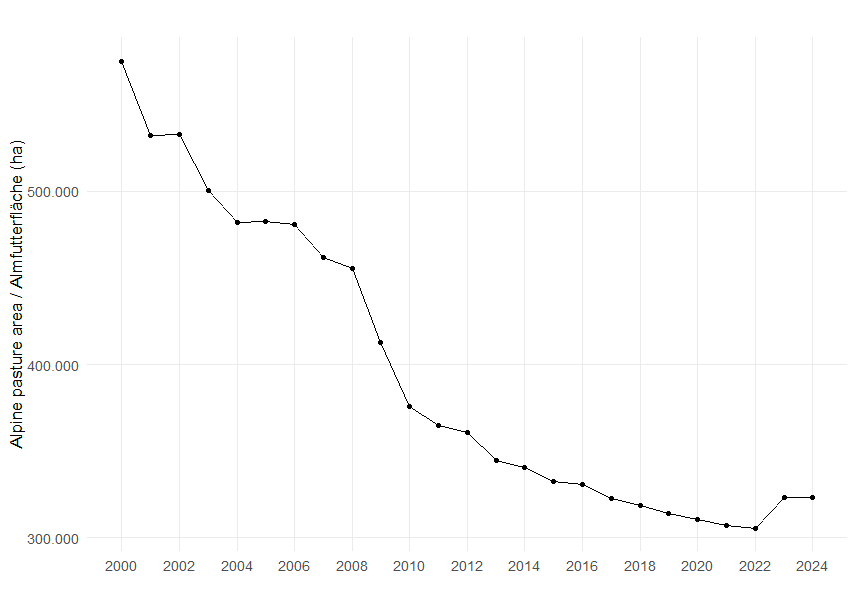
Figure 3: Alpine pasture area in Austria by year at the municipal level; Source: WIFO analysis
Focusing on the period since 2000 shows that the decline of alpine pastures has continued into recent decades. In the early 2000s, the alpine pasture area decreased relatively quickly. Around the end of that decade, the pace of decline slowed, but the overall trend remained negative.
The timing of this slowdown coincides with increased political attention to mountain farming and the introduction of targeted support measures under national and EU agricultural policies, particularly payments for areas with natural constraints and agri-environmental schemes (European Parliament & Council of the European Union, 2013; BMNT, 2018). However, the data indicate that these measures have not reversed the long-term trend. Instead, they appear to have moderated ongoing losses within a broader structural decline.
Looking at recent developments, therefore, reinforces the long-term perspective: current
policies may influence how fast alpine pastures are lost, but they have not fundamentally altered the trajectory shaped by decades of structural change.
Where alpine pastures still matter
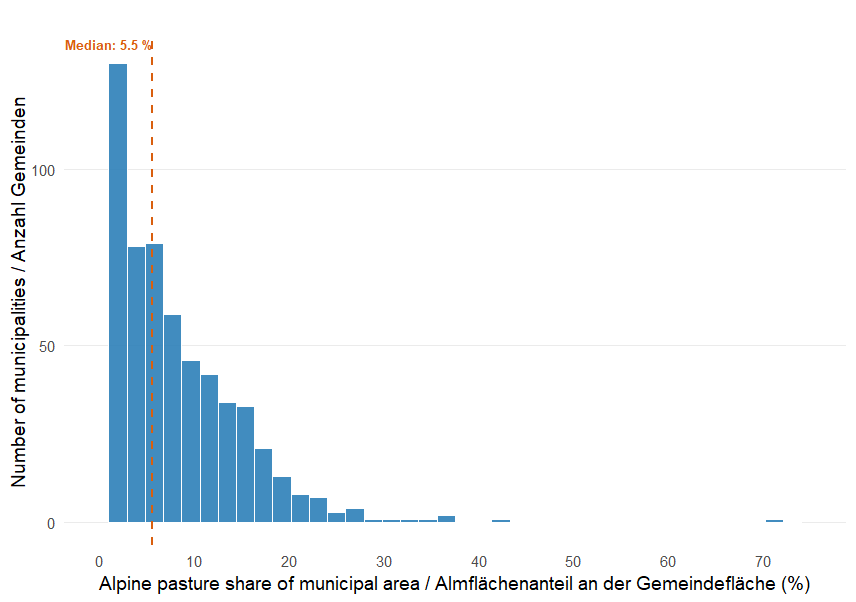
The distribution of alpine pastures across Austria is highly uneven. While alpine pastures are often perceived as a typical feature of mountain regions, they play only a minor role in most municipalities. In many cases, alpine pasture area accounts for just a small share of total municipal land.
At the same time, a relatively small number of municipalities still have a high proportion of alpine pastures. These areas concentrate a large share of the remaining alpine pasture land and carry most of the responsibility for maintaining alpine grazing systems. This spatial concentration means that changes in alpine pasture management have very different implications depending on location.
As a result, the decline of alpine pastures is not a uniform national issue but a regionally specific one. In municipalities where alpine pastures still matter, their loss has far-reaching consequences for land use, landscape character, and farming practices. In many other areas, however, alpine pastures have already become marginal or have disappeared entirely.
Comments
Loading comments...
Research Questions
Research Questions
Building on the motivation outlined above, the analysis focuses on three central questions:
- How has the area of alpine pastures in Austria changed over the long term, and how do recent developments compare to historical trends?
- How unevenly are alpine pastures distributed across municipalities, and where do they still play a significant role today?
- How do demography and participation in agri-environmental measures differ across regions?
Comments
Loading comments...
Methods
Methods
The analysis uses official Austrian time series data from the GEDABA database (Federal Ministry of Agriculture, Forestry, Regions and Water Management, 2024). We work with annual data at municipality level and, where relevant, district level. Key variables include alpine pasture area (ha), the number of alpine pastures, grazing animals on alpine pastures (cattle, sheep, goats, and horses) and their aggregate measure in livestock units (GVE), as well as utilized agricultural area with and without alpine pastures (ha). Municipality area (km²) and population are used to derive comparable indicators across regions.
We compile GEDABA indicator tables into a panel dataset by municipality/district and year, and we calculate cross-sectional indicators for the latest available year (currently 2024). These include: the share of alpine pasture area in total municipal area, grazing intensity (GVE per hectare of alpine pasture), the share of utilized agricultural area linked to alpine pastures, and participation in agri-environmental measures. In particular, we use the area under “site-adapted alpine pasture management” (ÖPUL Measure 14) and express it as a share of alpine pasture area. Missing values in alpine-related variables are treated as zero where appropriate.
The empirical work combines descriptive statistics and visualizations (time series, distributions, and bivariate plots) with regression models. We estimate (i) a logistic model for whether a municipality has any alpine pasture activity, (ii) linear models explaining the
municipal share of alpine pasture area among municipalities with alpine pastures, and (iii) linear models explaining changes in alpine pasture area between 2000 and 2024. Explanatory variables include population density, the share of agricultural land linked to alpine pastures, participation shares in agri-environmental measures, and federal state fixed effects. Additional models relate changes in alpine pasture area to demographic change (percentage population change between 2001 and 2024). Results are interpreted as statistical relationships in the data rather than strict causal effects.
Comments
Loading comments...
Results
How much alpine pasture area do municipalities have in 2024?
Looking only at municipalities that still have alpine pastures, we model what explains why some municipalities have a larger share of alpine pasture land than others. The model explains a fairly large part of the differences between municipalities (about 45%).
Main patterns:
Who loses alpine pasture area? Change between 2000 and 2024
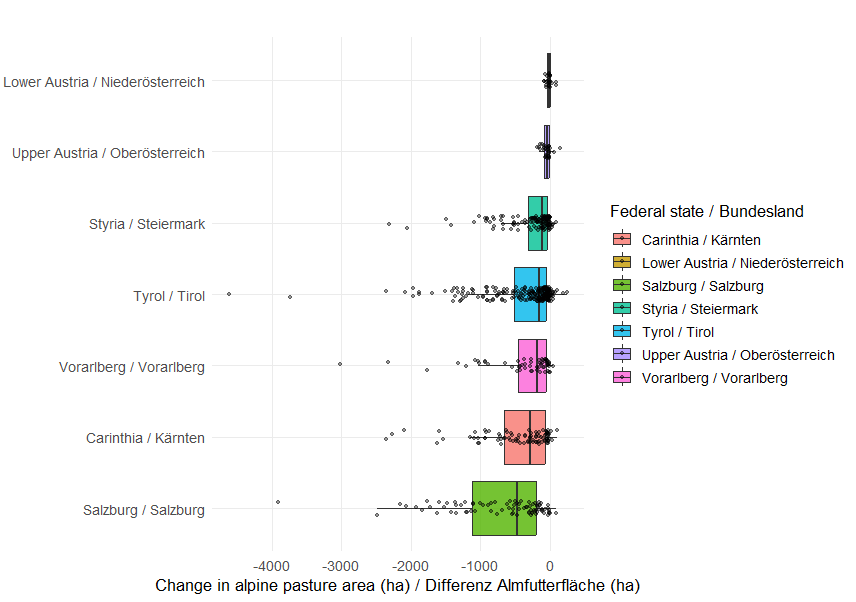
Figure 5: Change in alpine pasture area between 2000 and 2024 by federal state; Source: WIFO analysis
Comparing alpine pasture area in 2000 vs. 2024 at the municipality level shows that the decline is widespread (only municipalities with valid values in both years are included).
Overall, most municipalities lost alpine pasture area:
- The typical (median) change is about −158 hectares.
- The average (mean) change is about −386 hectares.
- Losses can be very large (down to about −4,609 ha), while gains are much smaller (up to about +255 ha).
When grouping municipalities by the size of change:
- Strong decline (more than −50 ha): 464 municipalities
- Slight decline (−50 to −10 ha): 100 municipalities
- Relatively stable (−10 to +10 ha): 57 municipalities
- Increase (more than +10 ha): 28 municipalities
The decline in alpine pasture area therefore clearly dominates, while increases are rare.
The largest absolute losses of alpine pasture area occur primarily in high-alpine municipalities with ecologically particularly valuable alpine grazing areas. These include, among others, municipalities in the Hohe Tauern and the Central Alps such as St. Jakob in Defereggen, Matrei in Osttirol, Prägraten am Großvenediger, Rauris, Fusch an der Großglocknerstraße, and Malta.
In these regions, alpine pastures are extensive, traditionally managed, and closely linked to species-rich high-elevation ecosystems. Corresponding losses of pasture area therefore imply not only a decline in agricultural use, but also the loss of ecologically and landscape-wise highly sensitive areas.
What is associated with larger losses vs. smaller losses?
A regression model suggests:
- Municipalities where alpine pastures are more closely tied to the overall agricultural
land-use system tend to have larger absolute losses in alpine pasture area. - Higher population density is linked to slightly smaller losses (this effect is small and
only borderline significant). - A higher coverage of site-adapted alpine pasture management (ÖPUL 14) is linked to
less severe decline.
Differences between federal states remain important.
Demographic change and alpine pasture decline (2001–2024)
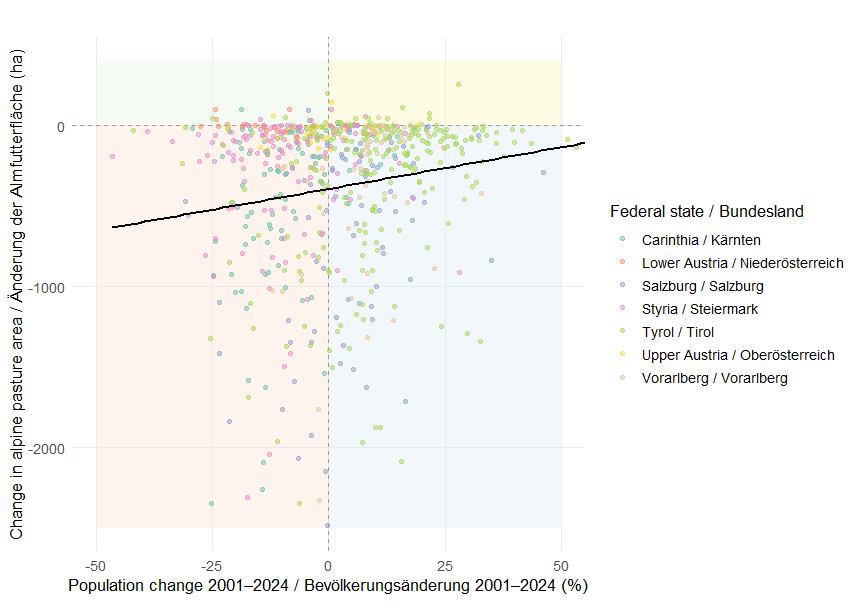
Figure 6: Population change and change in alpine pasture area at municipality level (2001–2024); Source: WIFO analysis
Figure 6 shows the relationship between population change and changes in alpine pasture
area at the municipality level between 2001 and 2024. The figure includes 649 municipalities with valid data for both population and alpine pasture area.
Each point represents one municipality. The horizontal axis shows population change, while the vertical axis shows the change in alpine pasture area. The dashed lines divide the figure into four quadrants, distinguishing municipalities with population growth or decline and increasing or decreasing alpine pasture area.
Overall, municipalities with population growth tend to experience smaller losses of alpine
pasture area, while municipalities with population decline more often show larger losses. The fitted trend line indicates a positive association between population change and alpine pasture change, although substantial variation remains across municipalities and regions.
When linking alpine pasture change with population development, one consistent pattern
emerges:
- Municipalities with population growth tend to have smaller losses of alpine pasture area.
- Municipalities with population decline tend to have larger losses.
In the model excluding Vienna, population change is a significant predictor:
- Roughly +4.4 hectares more alpine pasture area change (i.e., less loss) for each +1
percentage point of population change (2001–2024).
Comments
Loading comments...
Policy recommendations
Policy recommendations
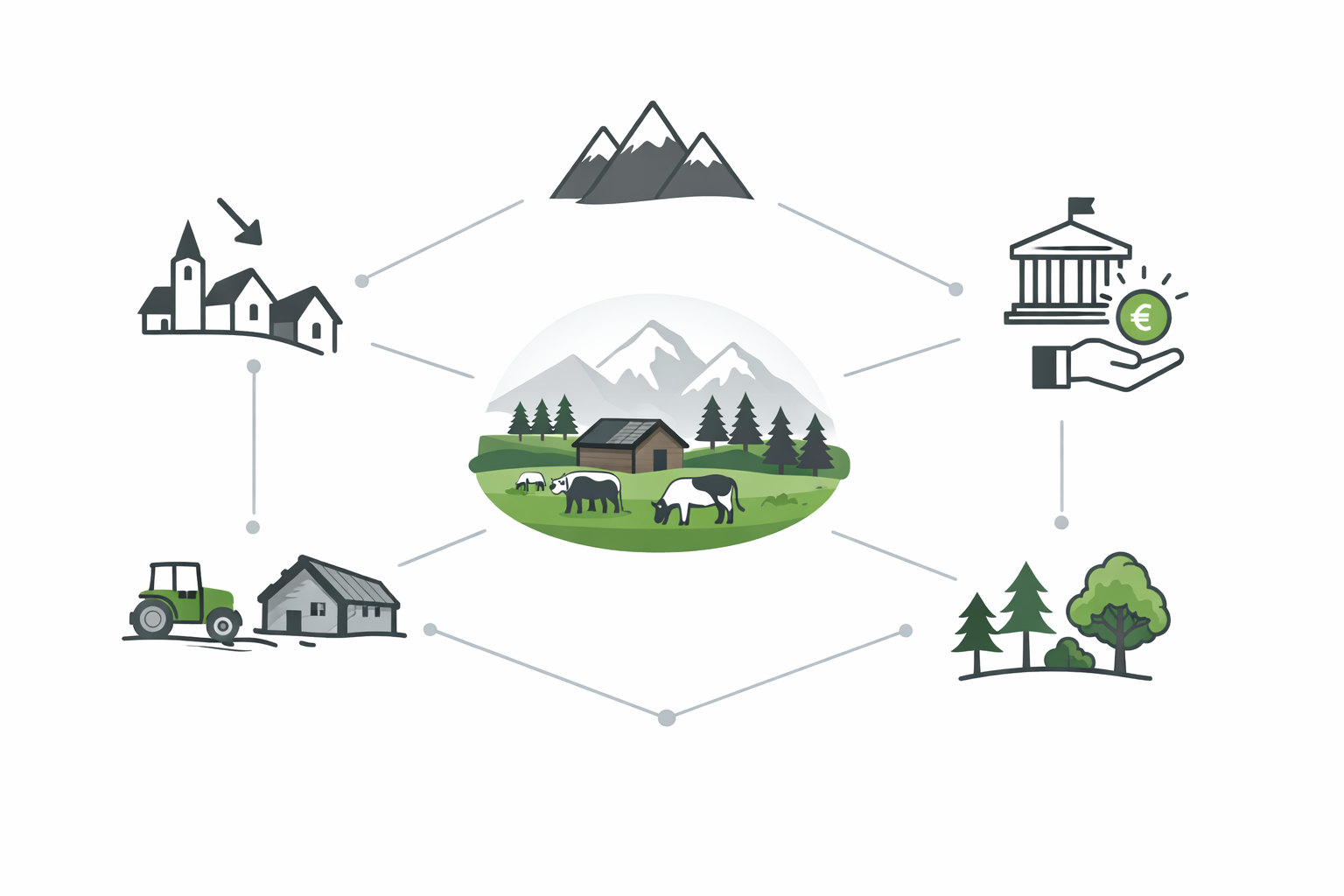
Figure 7: Alpine pastures as part of an interconnected socio-ecological system; Source: ChatGPT
The analysis shows that the decline of alpine pastures in Austria is long-term, regionally concentrated, and closely linked to structural and demographic factors rather than short-term management decisions. Policy responses therefore need to be realistic about what can be influenced by agricultural policy and where broader rural development strategies are required. Based on the findings, four main policy directions emerge.
Focus support on regions where alpine pastures still play a central role
Alpine pastures are increasingly concentrated in a limited number of municipalities. In many areas, they have already become marginal or have disappeared entirely. Policies aiming to maintain alpine pastures should therefore be spatially targeted. Rather than applying uniform national measures, support should prioritize municipalities where alpine pastures still make up a substantial share of land use and where their loss would have the greatest ecological, cultural, and landscape impacts. Concentrating resources in these regions increases the likelihood that policy measures have a tangible effect.
Strengthen long-term viability rather than short-term stabilization
The results suggest that existing support measures may slow down losses but do not reverse the long-term decline. This indicates that policies focused solely on maintaining current use levels are insufficient. Greater emphasis should be placed on improving the long-term viability of alpine pasture management, including labor availability, succession, and income stability. Measures that reduce administrative burden, support cooperation between farms, or link alpine pasture use more strongly to regional value chains (e.g. tourism) are likely to be more effective than short-term compensatory payments alone.
Integrate alpine pastures into broader rural and demographic policy
Population change emerges as a consistent factor associated with alpine pasture decline. Municipalities with population loss tend to experience stronger reductions in alpine pasture area. This highlights that alpine pasture management cannot be addressed by agricultural policy alone. Policies supporting rural infrastructure, services, and living conditions are indirectly but critically linked to the future of alpine pastures. Coordinating agricultural measures with regional development, mobility, and housing policies can help address the structural conditions that underpin land abandonment in mountain regions.
Use agri-environmental measures strategically, not uniformly
Participation in site-adapted alpine pasture management is associated with less severe
decline, but it does not appear to be a universal solution. This suggests that agri-environmental measures are most effective when they are well aligned with local conditions and embedded in broader land-use strategies. Rather than expanding participation indiscriminately, policies should focus on improving the design, flexibility, and regional fit of such measures, ensuring they support viable management systems where alpine pastures still play an active role.
Accept structural limits and plan for differentiated outcomes
Finally, the long-term and uneven nature of alpine pasture decline implies that not all losses can or should be prevented. In some regions, structural conditions may no longer support continued alpine pasture use. Policy should therefore distinguish between areas where maintenance is realistic and desirable, and areas where alternative land-use trajectories (e.g. natural succession, forest development) may be more appropriate. Making these distinctions explicit can help avoid unrealistic expectations and support more transparent and effective land-use planning.
Taken together, the findings suggest that maintaining alpine pastures requires a combination of targeted agricultural support, integrated rural development, and realistic recognition of long-term structural change. Policies that acknowledge this complexity are more likely to sustain alpine pastures where they still matter most.
Comments
Loading comments...
References
References
- Bätzing, W. (2015). Die Alpen: Geschichte und Zukunft einer europäischen Kulturlandschaft (4th ed.) [The Alps: History and future of a European cultural landscape]. C. H. Beck.
https://www.chbeck.de/baetzing-alpen/product/39979463 - Centeri, C. (2022). Effects of grazing on water erosion, compaction and infiltration on grasslands. Hydrology, 9(2), Article 34. https://doi.org/10.3390/hydrology9020034
- European Parliament & Council of the European Union. (2013). Regulation (EU) No 1305/2013 of 17 December 2013 on support for rural development by the European Agricultural Fund for Rural Development (EAFRD) and repealing Council Regulation (EC) No 1698/2005. Official Journal of the European Union, L 347, 487–548. http://data.europa.eu/eli/reg/2013/1305/oj
- Federal Ministry of Agriculture, Forestry, Regions and Water Management. (2024). GEDABA time series: Agricultural statistics at municipality and district level. https://gedaba.agrarforschung.at/zeitreihen
- Federal Ministry of Sustainability and Tourism (BMNT). (2018). Austrian programme for
rural development 2014–2020 (Version 5). https://www.bmluk.gv.at/dam/jcr:8f5ab741-d8a9-43b5-9088-d7c5d63dd8cf/Prog_05_02%20V_5%20web.pdf - Flury, C., Huber, R., & Tasser, E. (2013). Future of mountain agriculture in the Alps. In S. Mann (Ed.), The future of mountain agriculture (pp. 23–36). Springer Geography. https://doi.org/10.1007/978-3-642-33584-6_8
- Sinabell, F., & Renhart, A. (2024). Landwirtschaft 2023: Entwicklung, Einkommen und
agrarpolitischer Kontext in Österreich (WIFO Monatsberichte, 9/2024). Austrian
Institute of Economic Research (WIFO). https://www.wifo.ac.at/wp-content/uploads/upload-9970/mb_2024_09_03_landwirtschaft_2023.pdf - UNESCO. (2023). Transhumance, the seasonal droving of livestock. Representative List of the Intangible Cultural Heritage of Humanity. https://ich.unesco.org/en/RL/transhumance-the-seasonal-droving-of-livestock-01964
Comments
Loading comments...