
 Europe
 Austria
 Belgium
 Bulgaria
 Croatia
 Czech Republic
 Denmark
 Estonia
 Finland
 France
 Germany
 Greece
 Hungary
 Ireland
 Italy
Italy Latvia
 Lithuania
 Luxembourg
 Malta
Malta Netherlands
 Norway
 Poland
 Portugal
 Romania
 Slovakia
 Slovenia
 Spain
Spain SwedenEurope
Motivation
Motivation
Climate change poses a challenge for Austrian agriculture to both adapt its production systems to changing climatic conditions and reduce its greenhouse gas emissions. Rising temperatures, changing precipitation patterns, and an extended growing season affect yield levels, yield stability, and the relative competitiveness of arable farming and grassland use. In particular, where sufficient water supply is available, increasing average temperatures can lead to higher grassland productivity, while certain regions and arable crops face increased adaptation needs regarding variety selection and crop rotations, soil cultivation methods, fertilization intensity, cutting frequency, grazing management, and irrigation management (Olesen & Bindi, 2002).
The adaptation of agriculture to climate change does not occur in isolation at the level of individual crops, but rather as part of strategic farm planning based on expected future production and income opportunities. These opportunities arise due to changes in economic and agricultural policy frameworks, as well as personal attitudes, beliefs, and behaviors, and family structures, processes, and circumstances at the farm level.
Against this background, we examine possible and efficient adaptation measures in Austrian agriculture under different climate scenarios up to the middle of the century. For this purpose, a model framework is used that considers the average impacts of climate change around 2050 and examines selected adaptation measures in arable land and permanent grassland management in Austria.
Comments
Loading comments...
Research question
What adaptation to climate change will be required for Austrian agriculture by mid-century?
Comments
Loading comments...
Data and methods
Model framework
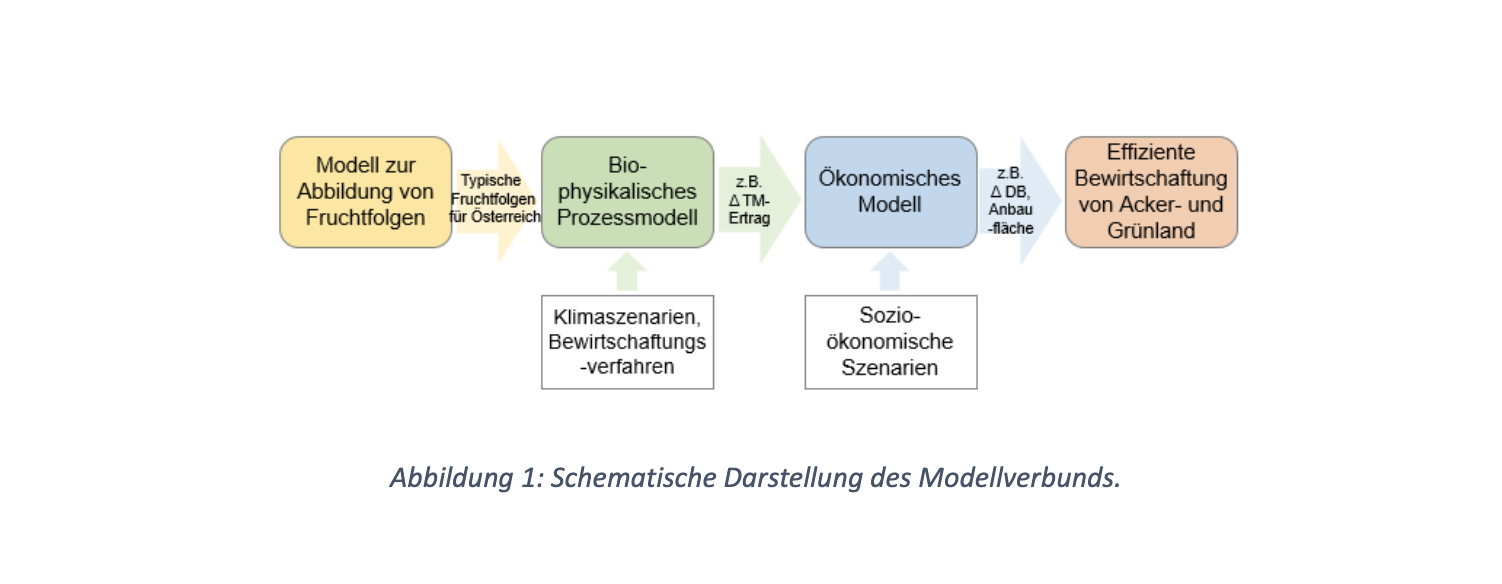
Figure 1: Schematic representation of the model framework.
To model adaptation needs in Austrian agriculture under selected climate scenarios, an integrated model framework was applied (see Figure 1). This framework consists of three models:
- The crop rotation model CropRota (Schönhart et al., 2011) to generate typical crop rotations at the municipal level.
- The biophysical process model EPIC (Izaurralde et al., 2006; Izaurralde et al., 2017; Williams, 1995) to simulate the impacts of climate change on crop yields and selected environmental indicators at a spatial resolution of 1 km over a period of 40 years. EPIC simulations were conducted for both typical and alternative management practices in order to capture adaptation needs and options.
- The economic, spatially explicit land-use optimization model BiomAT (Mitter & Schmid, 2019; Jost et al., 2025) to identify efficient adaptation measures and strategies in Austrian agriculture.
The models are applied sequentially and provide agronomic, economic, and ecological results for arable and grassland management. Specifically, for Austria we (i) identified efficient agricultural adaptation measures to selected climate scenarios for the period 2031–2070, and (ii) quantified the impacts on agricultural production.
The biophysical process model EPIC (version EPIC0810) simulates crop yields as well as hydrological and agro-ecological processes—such as evapotranspiration, nitrogen–carbon–phosphorus cycles, and erosion—for each 1 km grid cell of agricultural land and management practice. EPIC incorporates, among other inputs, daily weather data for the climate periods 1981–2020 and 2031–2070, data on spatially dominant soil types and properties, topographic data such as elevation and slope, and data on typical and alternative management practices, including sowing and harvest dates, tillage practices, fertilization, plant protection, irrigation management, crop rotations, and cutting frequencies. EPIC provides annual dry matter yields for arable land and grassland, as well as environmental indicators such as N₂O emissions, for each simulated 1 km grid cell and management practice.
BiomAT is a nonlinear, spatially explicit land-use optimization model that maximizes total net revenue (i.e. revenues minus costs) from arable and grassland production, taking into account the agricultural land endowment at a 1 km grid resolution across Austria. In the model, the total agricultural area per grid cell and the total area of permanent grassland—i.e. intensive and extensive permanent grassland and alpine pastures—are held constant. This ensures compliance with national regulations for the preservation of permanent grassland. Average gross margins are calculated based on dry matter yields for arable land and grassland simulated with EPIC, corresponding agricultural prices, and variable production costs (e.g. costs for tillage, seed, fertilizers, plant protection, harvesting, labor, and insurance). Agricultural subsidies, including direct payments and agri-environmental payments, are incorporated in BiomAT. Agricultural prices are obtained from Statistics Austria, and variable production costs are taken from the standard gross margin catalog of the BAB. Agricultural prices, variable production costs, and agricultural policy payments are kept constant in order to isolate the effects of climate change and identify adaptation needs in agriculture.
Climate scenarios
We use a historical reference period (1981–2020) and four regionally downscaled climate change scenarios for a future period (2031–2070) with a temporal and spatial resolution of 1 day and 1 km. The climate scenarios represent moderate (ICHEC45, ICHEC85), dry (MOHC45), and wet (IPSL85) climate conditions, as well as moderate (RCP4.5) and high (RCP8.5) radiative forcing in Austria. These scenarios are taken from the ÖKS15 dataset for Austria, which is based on the EURO-CORDEX database (Chimani et al., 2016).
Management practices
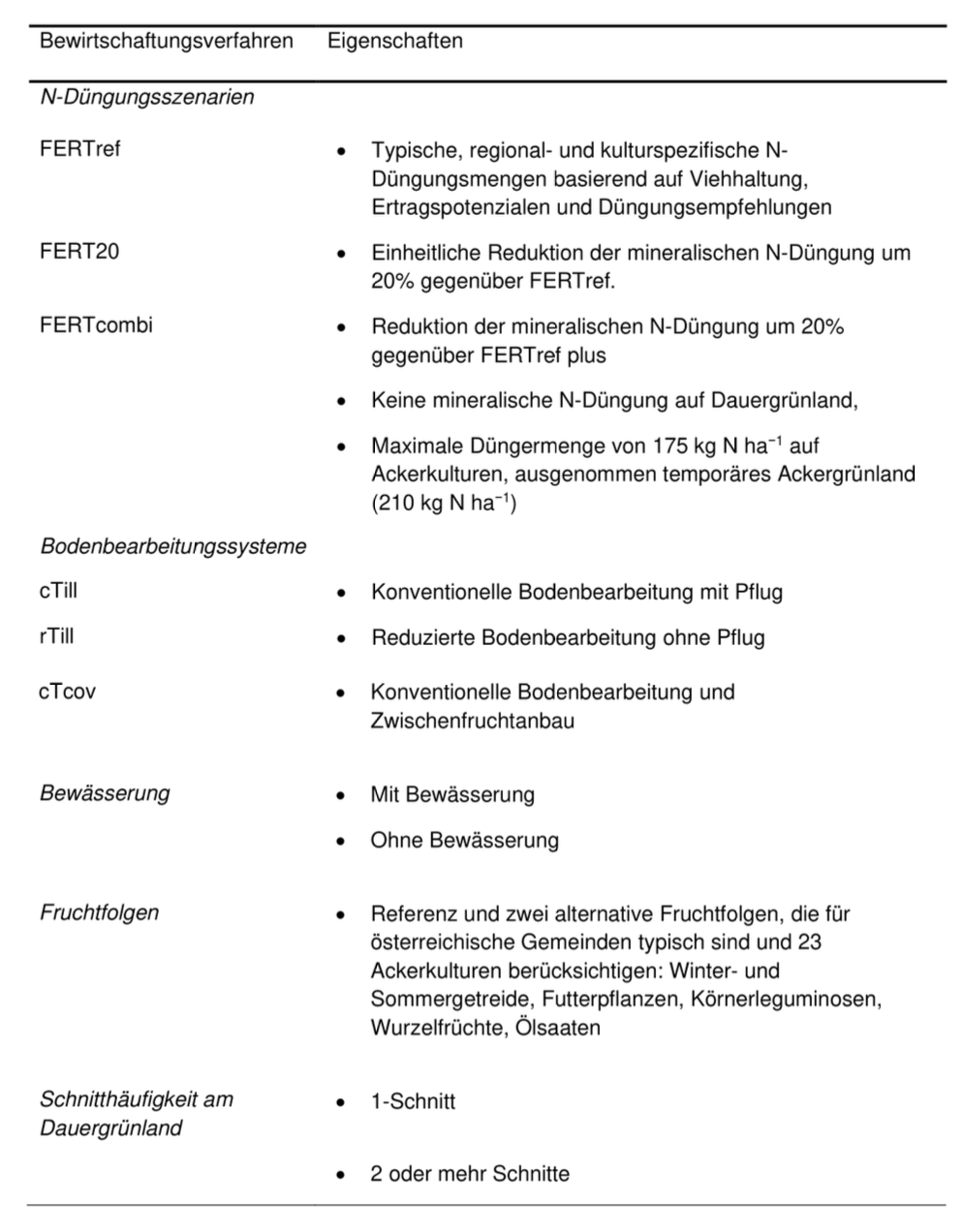
Typical agricultural management practices for adaptation to climate change are considered within the model framework and are listed in Table 1.
Comments
Loading comments...
Model Results
Model Results
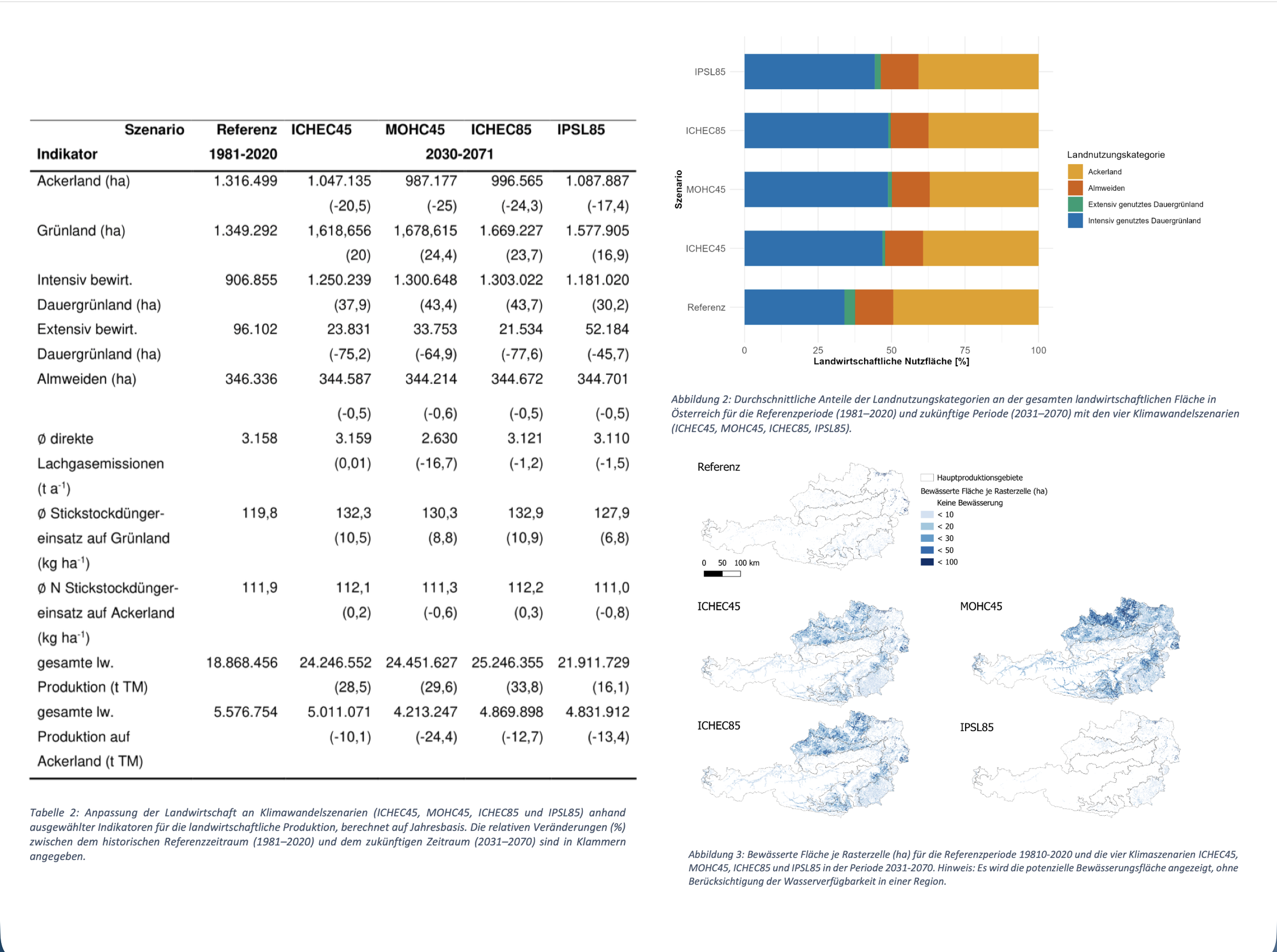
Table 2 presents the model results for the reference period (1981–2020) and the future period (2031–2070), i.e. the model-based efficient adaptation to the impacts of the four climate scenarios (ICHEC45, MOHC45, ICHEC85, and IPSL85). Relative changes (%) are calculated by comparing the reference period (1981–2020) with the future period (2031–2070).
In the reference period (1981–2020), arable land accounted on average for 49.4% of the total agricultural area in Austria (2,665,792 ha). Permanent grassland comprised on average 34% intensively managed permanent grassland (i.e. two or more cuts), 3.6% extensively managed permanent grassland (i.e. single-cut areas), and 13% alpine pastures.
The model results show that, under efficient adaptation to climate change, the average annual nitrogen fertilizer application on permanent grassland increases by between 6.8% and 10.9% compared to the reference period, which averaged 119.8 kg N ha⁻¹. This intensification of permanent grassland management is associated with an increase in multi-cut areas and a decrease in single-cut areas. The results also show that the average annual nitrogen fertilizer application on multi-cut grassland decreases by 2% (ICHEC45) to 3.8% (MOHC45) compared to the reference period (170.3 kg N ha⁻¹). On arable land, fertilizer intensity remains largely unchanged on average compared to the reference period (111.9 kg N ha⁻¹).
Average annual direct N₂O emissions from agricultural soils decrease under the climate scenarios MOHC45 (−16.7%), ICHEC85 (−1.2%), and IPSL85 (−1.5%), while remaining unchanged under the ICHEC45 scenario compared to the reference period (3,158 t N₂O yr⁻¹). This can be explained by increased nitrogen use efficiency, particularly on permanent grassland.
Average crop production across the entire agricultural area increases under all climate scenarios, with the magnitude of the increase depending on the respective scenario, ranging from 16.1% (IPSL85) to 33.8% (ICHEC85) compared to the reference period (18.9 million t dry matter). In contrast, average crop production on arable land declines by between −10.1% (ICHEC45) and −24.4% (MOHC45) compared to the reference period (5.6 million t dry matter).
Comments
Loading comments...
Conclusions
Conclusions
The model results indicate that, under efficient adaptation, the impacts of climate change in Austria are associated with a substantial increase in permanent grassland production. Rising temperatures, combined with sufficient water availability, lead to longer growing seasons and—under efficient adaptation measures and utilization options—to higher grassland yields. For agricultural practice, a key question is the extent to which the additionally produced grassland biomass can actually be utilized, or whether parts of the increased growth remain unused. This is particularly relevant in regions with limited livestock numbers or restricted mechanization potential. Moreover, the question arises as to realistic and economically viable utilization options for permanent grassland. Possible options include increased grassland-based feeding, extended grazing periods, or alternative uses such as energy production in biogas plants. The implementation of such utilization strategies depends on farm-level, regional, and agricultural policy frameworks, which influence whether increasing grassland production is primarily used as a production potential or maintained mainly as a landscape and environmental service.
Comments
Loading comments...