
 Europe
 Austria
 Belgium
 Bulgaria
 Croatia
 Czech Republic
 Denmark
 Estonia
 Finland
 France
 Germany
 Greece
 Hungary
 Ireland
 Italy
Italy Latvia
 Lithuania
 Luxembourg
 Malta
Malta Netherlands
 Norway
 Poland
 Portugal
 Romania
 Slovakia
 Slovenia
 Spain
Spain SwedenEurope
On this page
Motivation
Carbon sequestration pratices in arable land
Carbon sequestration practices in arable land represent a set of possibilities to store carbon within agricultural cropping systems, such as the use of cover crops, reduced tillage, permanent grassland, and the integration of landscape elements such as hedgerows and agroforestry systems. These practices differ substantially in terms of implementation costs, carbon sequestration potential, contact obligations including management requirements and contract duration. While some solutions can be easily incorporated into existing crop rotations with limited long-term consequences, others require more durable commitments or involve permanent land-use changes, potentially creating important economic and behavioral barriers to adoption.
Focus on low-adoption but high-impact practices
This study focuses on two carbon sequestration practices that are currently less widely adopted despite their environmental benefits: perennial grass (e.g., clover) and hedgerows. These practices were selected because they differ strongly in the extend of commitment they require from farmers and also considerably affect their current land productivity.
Comments
Loading comments...
Carbon sequestration practices considered
Perennial grassland
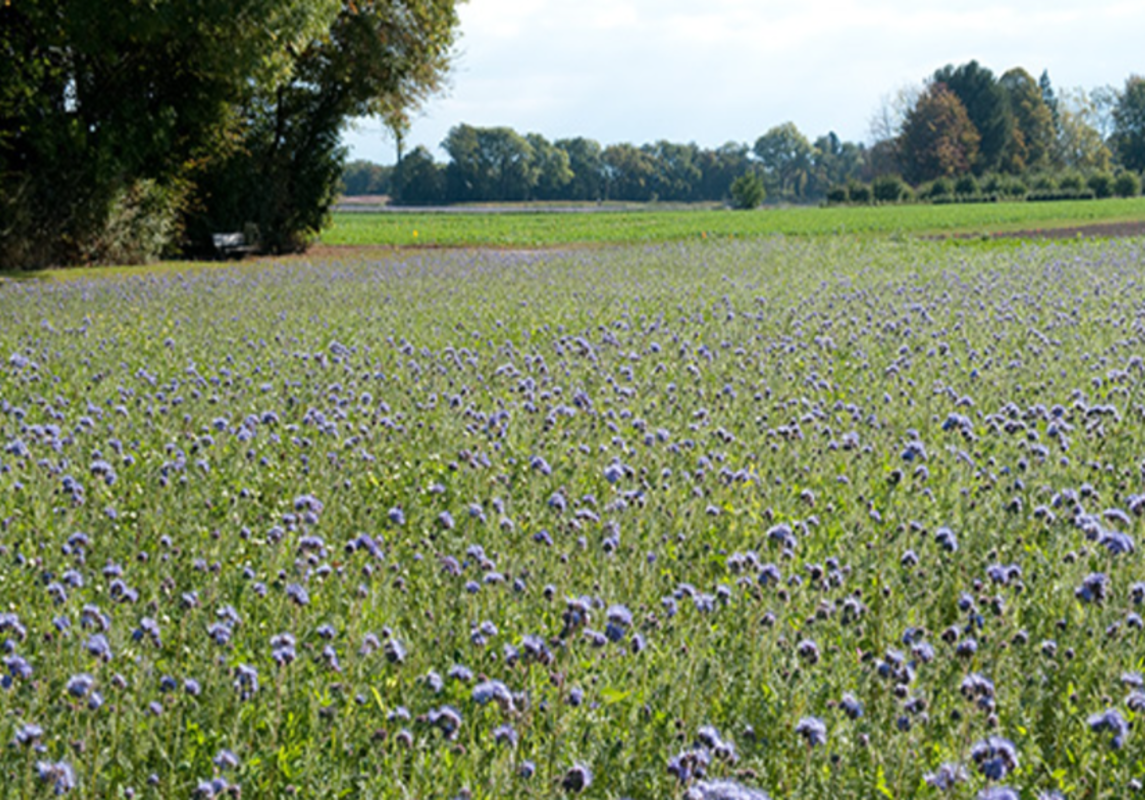
Perennial grassland (ZHAW)
Perennial grasslands, including grass–clover systems, represent multifunctional agro-ecosystems that provide a low-cost forage base while supporting soil carbon sequestration (Loges et al., 2024).
The average carbon sequestration rate of perennial grassland is approximately 0.5 t C/ha/year during the first 20 years for the study area, but may vary between 0.2 and 0.8 t C/ha/year depending on weather, soil charactersistics, and management effort (Wüstemann et al., 2023). Beyond carbon sequestration, they deliver several ecosystem services. In fact, perennial grasslands improve soil structure, reduce erosion, support biodiversity, and may decrease the need for mineral fertilizers and pesticides, contributing to long-term soil productivity.
Hedgerows
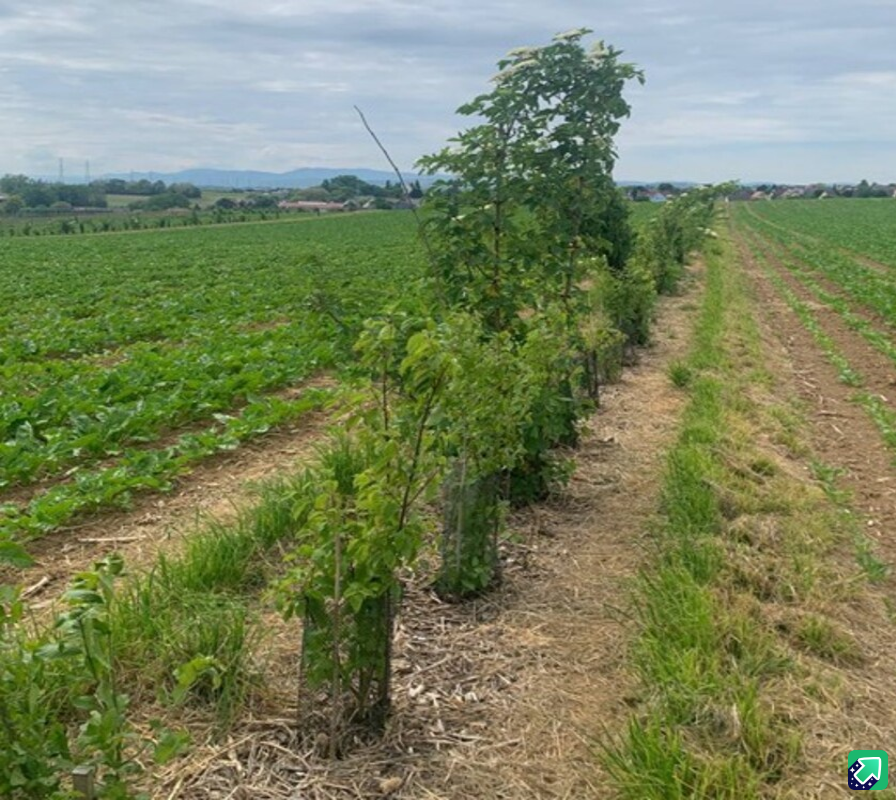
Hedgerows, our picture
Hedgerows are permanent linear woody landscape elements established along field boundaries. They typically consist of mixed native tree and shrub species adapted to local site conditions. Structurally, hedge width generally ranges between about 3 and 10 m, depending on regional design and management requirements (Wüstemann et al. 2023).
As a climate mitigation measure, hedgerows show comparatively high biomass accumulation during the first 20 years after establishment. The average carbon sequestration rate of hedgerows is approximately 4.6 tC/ha/yr for the study area, but may vary between 3.7 to 5.5 tC/ha/yr, including both above- and below-ground biomass (Wüstemann et al. 2023).
Beyond carbon sequestration, hedgerows provide important co-benefits such as biodiversity enhancement, erosion control, wind protection, improved microclimate, reduced nutrient losses, and increased landscape connectivity. Due to their permanence and multifunctionality, hedgerows represent a synergy-enhancing measure combining climate protection and agroecological resilience.
Comments
Loading comments...
Research Questions
Research Questions
This study addresses the following questions:
- What minimum compensation (in Euro per ton of carbon) do arable farmers require to adopt each of the considered carbon sequestration practices?
- How much arable area would they be willing to dedicate to these practices under the selected compensations?
Comments
Loading comments...
Survey with farmers
Survey with farmers
We conducted a structured survey with both arable and mixed arable farmers in two German regions, Baden-Württemberg and Bavaria, which are our study area . Participants were presented with clearly defined contracts for carbon sequestration practices and were asked to indicate the minimum compensation they would require to adopt them.
The contracts to evaluate were designed relative to a representative farm typical of the region. Using a predefined crop rotation, we estimated baseline farm income and computed the opportunity cost of implementing each practice. Survey participants could choose whether they wanted to implement only one of the selected practices, both practices, or none of the practices.
By asking farmers to the minimum payment they would request for implementing the considered practices, the survey captures the level of economic incentives needed to make them attractive in practice. In this context, the willingness to accept question was formulated similarly as it is done in environmental auctions to avoid overpricing. In addition to the contract evaluation section, basic information on farm characteristics and farmer profiles was collected to better understand differences in responses and adoption potential.
Comments
Loading comments...
Results
Carbon sequestration practices chosen by farmers
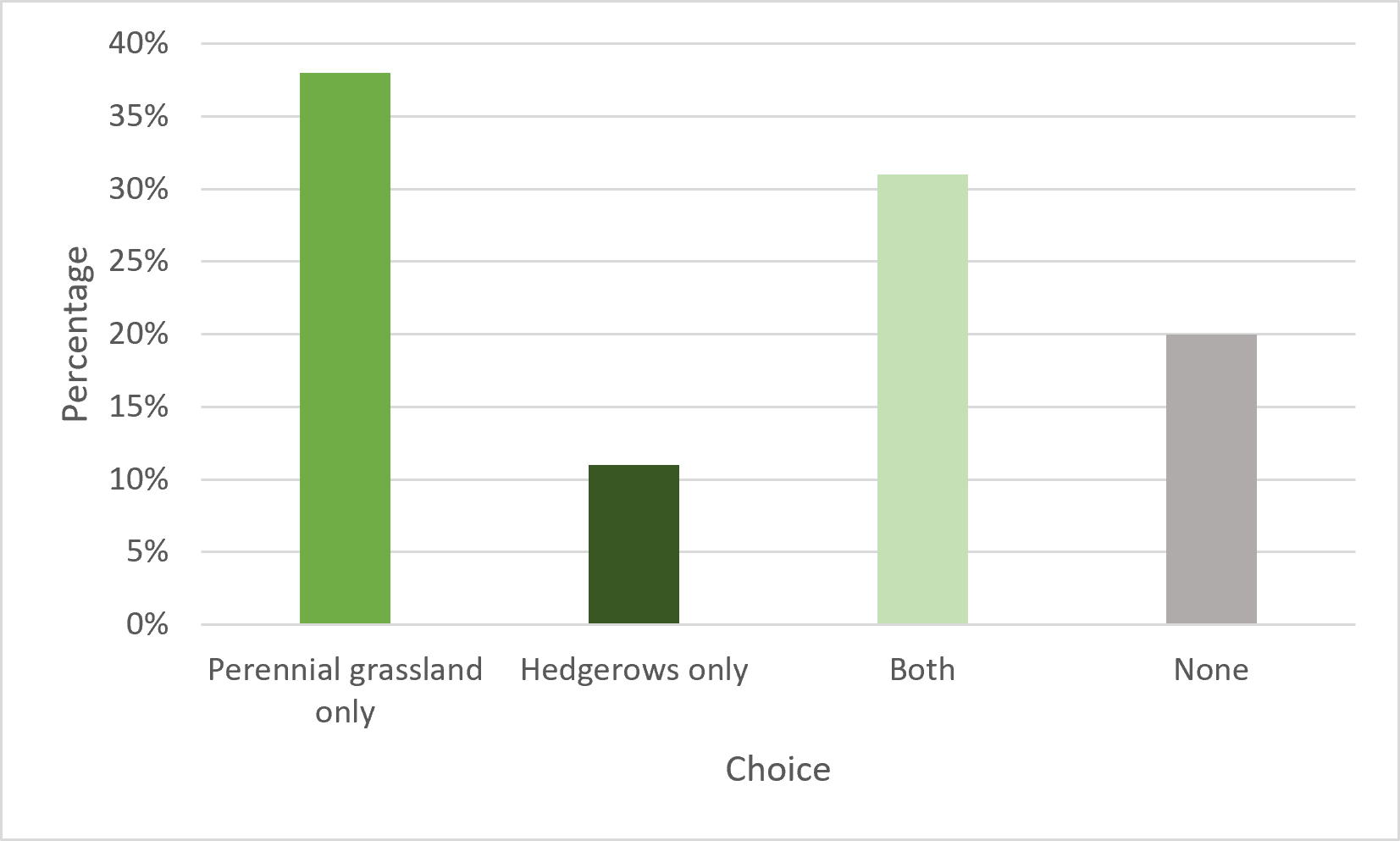
So far, 45 farmers Baden-Württemberg and Bavaria completed the survey and evaluated the proposed carbon sequestration contracts.
Choice was considerably higher for perennial grass adoption compared with hedgerow implementation. 38% of farmers were willing to adopt perennial grass (clover) only, while 31% expressed willingness to adopt both practices. In contrast, only 11% selected hedgerows as a stand-alone option, and 20% rejected both contracts.
Carbon prices for carbon sequestration practices
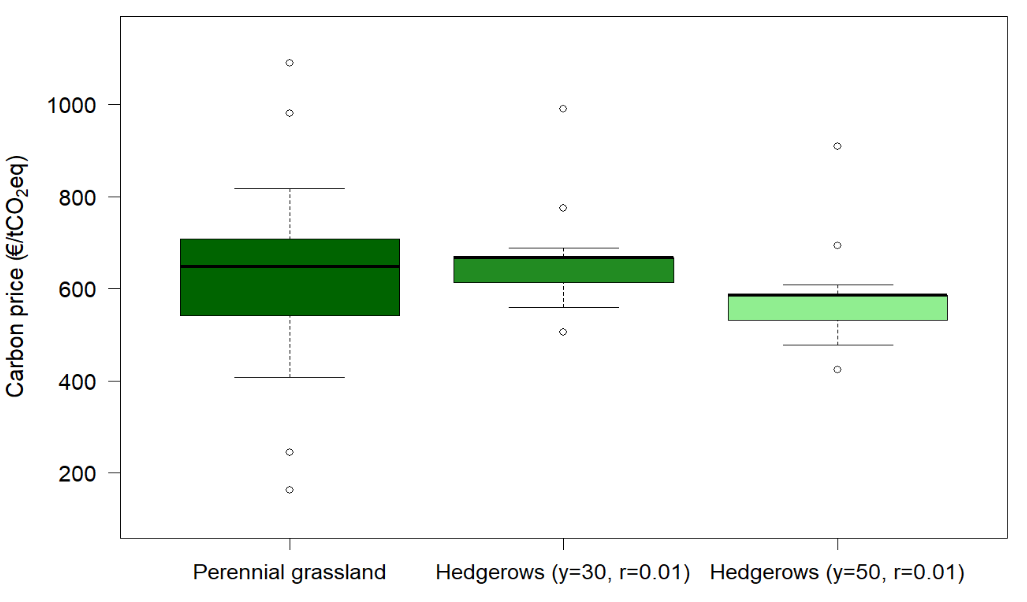
Carbon prices per tCO₂eq across sequestration practices
Farmers’ stated payments for perennial grassland and hedgerows are then converted into carbon prices by dividing the payment they asked for by the amount of carbon each practice is expected to store every year. In the case of hedgerows, the payments were discounted over the expected contract term at an interest rate of 1%.
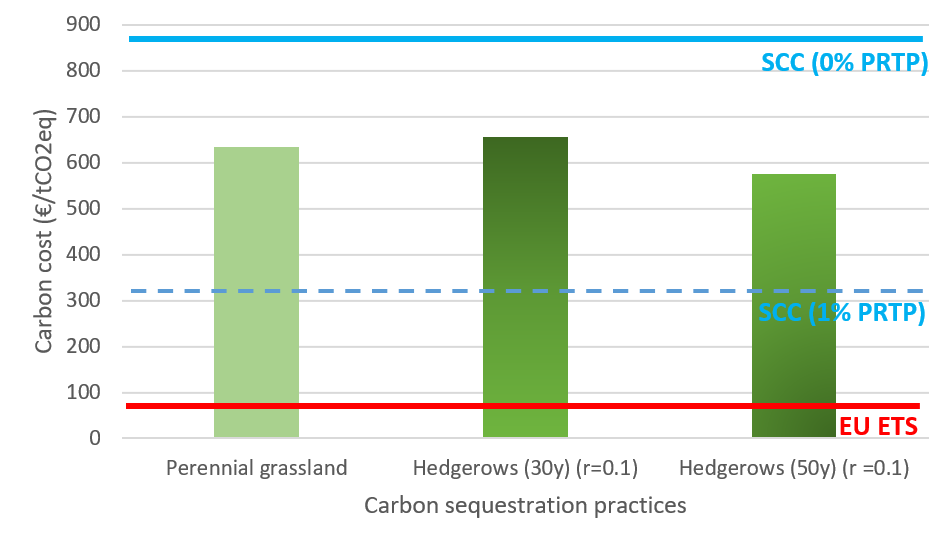
To adopt perennial grassland (e.g., clover), farmers requested an average carbon price of around €634 per tonne of CO₂ equivalent. For hedgerows, the required carbon price depends on how long the carbon is assumed to remain stored. It is approximately €655 per tonne assuming a 30-year carbon storage period, or approximately €575 per tonne assuming a 50-year storage period.
Comparison with existing carbon price benchmarks
Comparison of carbon prices
The resulting carbon prices are substantially higher than prices observed in compliance carbon markets. In particular, they are well above the 2025 average EU Emissions Trading System (EU ETS) prices of around €73 per tCO₂eq. However, this comparison should be interpreted with caution. EU ETS prices reflect the cost of reducing emissions in regulated industrial sectors, whereas the carbon prices presented here reflect the compensation farmers require to make voluntary land-use changes and store carbon under uncertain outcomes and long-term commitments.
Carbon supply at different carbon price level
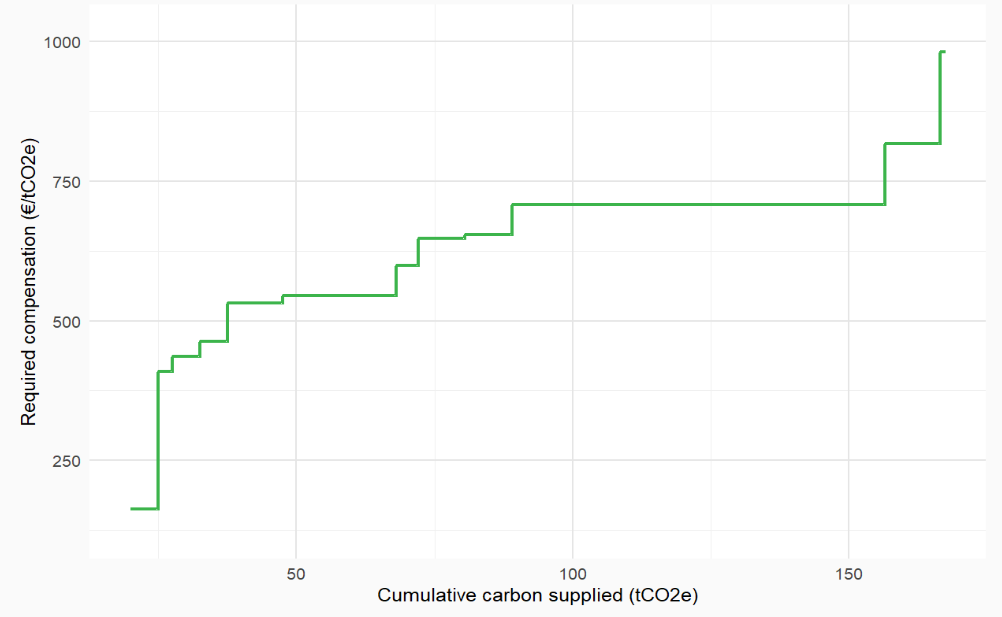
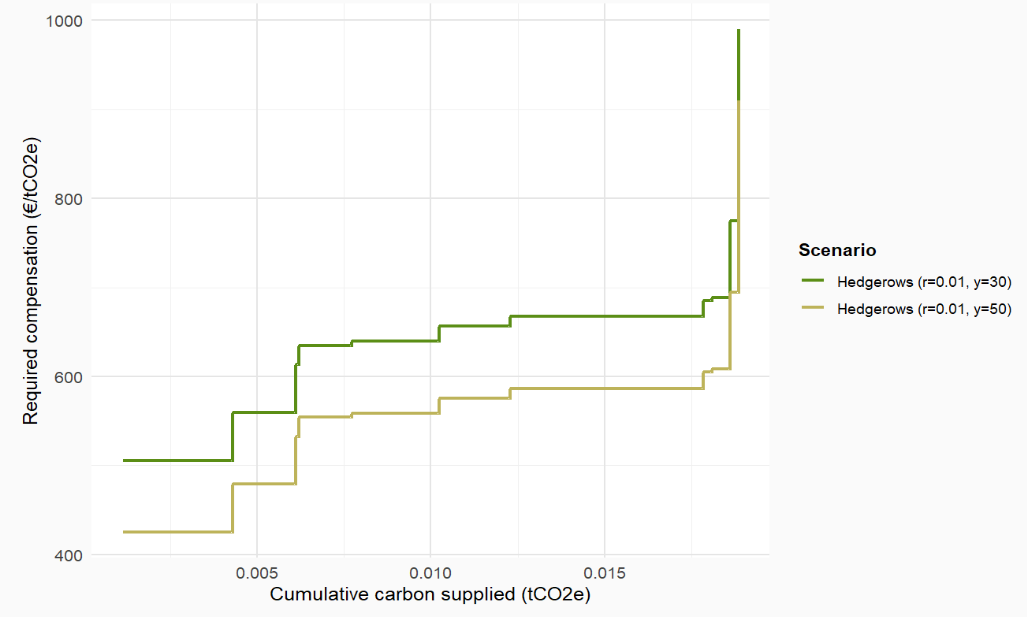
For each carbon price level, we can estimate how much carbon would be stored if these payments were offered to farmers to encourage the adoption of perennial grassland and/or hedgerows. The supply curves shown below illustrate how carbon supply increases with higher carbon price levels, based on farmers’ stated compensation requirements.
Carbon supply curve for perennial grass
Carbon supply curve for perennial grass
The carbon supply curve of perennial grassland indicates that moderate compensation levels can unlock a substantial share of carbon storage potential. However, achieving higher mitigation targets would require higher compensation levels.
Carbon supply curve for hedgerows
Carbon supply curve for hedgerows
Carbon supply from hedgerows increases as carbon price levels rise. However, the price required per tonne of CO₂ is relatively high compared to the amount of carbon stored. The 50-year carbon permanence scenario consistently requires higher carbon prices than the 30-year scenario at comparable supply levels. As a result, longer-term contracts imply greater overall budget commitments to achieve the same amount of carbon sequestration.
Comments
Loading comments...
Key insights
Key insights
- Farmers demand higher carbon prices for both carbon sequestration practices when compared to the prices that compliance carbon markets currently offer.
- However, these payments can still be justified from a societal perspective when compared to the estimates of the Social Cost of Casrbon, under low discount rated (0% and 1%).
- Permanent land-use change faces limited acceptance. Even when allowed to state their preferred compensation level, fewer than half of farmers are willing to consider long-term hedgerow contracts. This suggests that financial incentives alone may not be sufficient to overcome structural and behavioral barriers.
Comments
Loading comments...
References
References
Loges, R., Vogeler, I., Kluß, C., Hasler, M., & Taube, F. (2024). Renovation of grasslands with grass and white clover–Effects on yield and carbon sequestration. Soil and Tillage Research, 240, 106076.
Matthey, A., Bünger, B. C. € Eser, N. (2024). Methodological Convention 3.2 for the Assessment of Environmental Costs: Cost Rates: Version 10/2024. German Environment Agency (UBA).
Wüstemann, F., Schroeder, L. A., Witte, T. D., Don, A., & Heidecke, C. (2023). Steckbriefe zu humuserhaltenden und-mehrenden Maßnahmen auf Ackerflächen: Projektbericht des Thünen-Instituts im HumusKlimaNetz.
Comments
Loading comments...